


 Ontario’s social housing sector is rapidly becoming a major driver of demand for high-performance building products — from advanced envelope systems to triple-glazed windows and high-efficiency ventilation equipment.
Passive House Canada is pleased to announce the release of a new report:
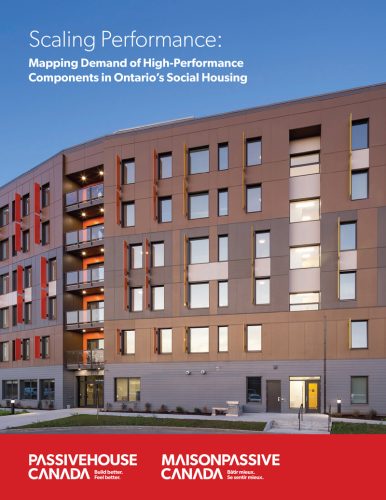
Scaling Performance: Mapping Demand of High-Performance Components in Ontario’s Social Housing
Prepared as part of the Codes Acceleration Fund (CAF), funded by Natural Resources Canada’s Energy Efficiency Program, the report examines how social housing providers across Ontario are adopting high-performance construction strategies and what that means for manufacturers, suppliers, designers, and policymakers.
The study analyzed 17 recently designed or constructed social housing developments from:
- CityHousing Hamilton
- Ottawa Community Housing
- Toronto Community Housing
- Windsor-Essex Community Housing Corporation
Together, these projects represent:
- more than 130,000 m² of gross floor area,
- over 1,400 residential units, and
- a growing shift toward high-performance building standards in affordable housing.
Key Findings
The report identifies clear trends across three critical product categories: building envelope systems, windows and glazing, and ventilation equipment.
High-Performance Envelopes Are Becoming Standard
Across the projects studied, building assemblies consistently incorporated:
- continuous exterior insulation,
- high thermal resistance assemblies,
- improved airtightness strategies, and
- prefabricated systems to reduce construction time and improve quality control.
Several projects targeted airtightness levels well beyond current code requirements, with one project achieving 0.4 ACH at 50 Pa.
Triple-Glazed Windows Are Now Common Practice
All buildings analyzed specified triple-glazed window systems with thermally broken frames.
Even high-rise developments with large glazed areas adopted high-performance fenestration systems to improve:
- occupant comfort,
- energy efficiency,
- condensation resistance, and
- long-term durability.
- Ventilation Systems Are Evolving
Nearly all projects used semi-centralized or decentralized HRV/ERV systems with heat recovery efficiencies of 75% or greater.
The report also identified growing interest in integrated systems that combine ventilation, heating, and cooling to simplify installation, maintenance, and operations.
A Strong Demand Pipeline Through 2030
One of the report’s most significant findings is the scale of anticipated future demand.
Based on projections from major Ontario social housing providers, anticipated development plans through 2030 could include:
- approximately 13,700 new housing units,
- across 60 new projects,
- representing an estimated:
- 769,000 m² of wall area,
- 163,000 m² of window area, and
- demand for more than 150 HRV/ERV units.
These figures highlight the growing role of social housing providers as market leaders in Canada’s transition toward low-carbon, high-performance construction.
Why This Matters
Social housing providers are increasingly being asked to deliver buildings that meet ambitious energy and climate targets while remaining affordable, durable, and resilient.
As funding programs and building policies continue to evolve toward Net-Zero Energy Ready and other advanced performance standards, manufacturers and suppliers have a significant opportunity to align products and services with emerging market needs.
The report identifies where demand is accelerating, where supply gaps remain, and where industry can strategically position itself in a rapidly growing high-performance market.


